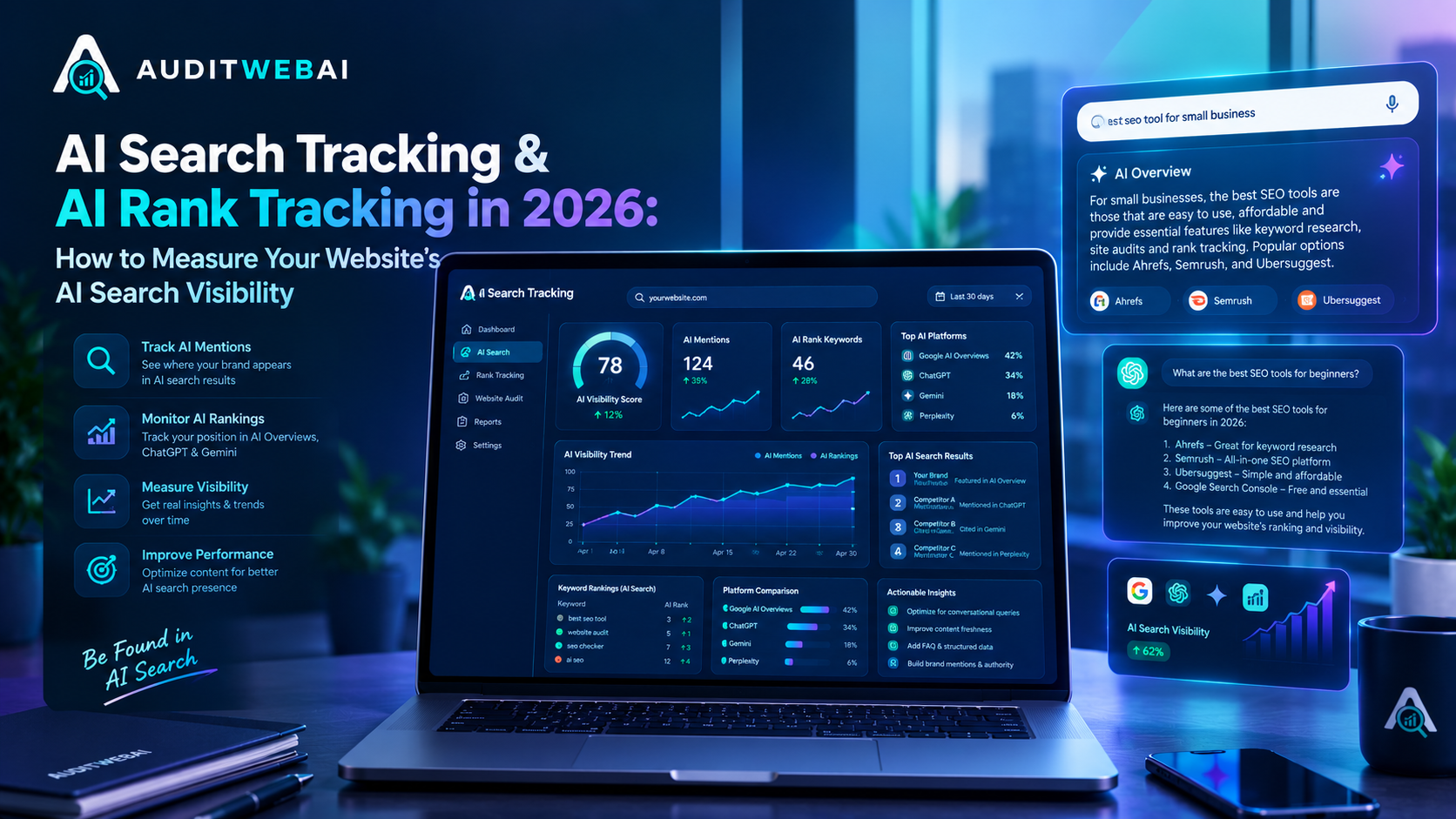
Search is changing.
For years, website owners mainly watched one number:
Where does my website rank on Google?
That metric is still important. But in 2026, it is no longer the only visibility question worth asking.
People increasingly use conversational and AI-powered search experiences to research topics, compare products, find businesses, solve problems, and discover websites.
Google Search now includes experiences such as AI Overviews and AI Mode, while AI-powered platforms are also changing how users discover information.
This creates a new challenge for website owners:
How do you know whether your website is actually visible in AI-powered search?
That is where AI search tracking and AI rank tracking become useful.
Instead of looking only at traditional keyword rankings, you can start monitoring a broader set of signals:
-
AI search visibility
-
Brand mentions
-
Page citations
-
AI search appearances
-
Search queries
-
Traditional rankings
-
Organic impressions
-
Clicks
-
Search Console performance
-
Content visibility
-
Changes over time
Google's current guidance is clear that traditional SEO fundamentals remain important for generative AI features. Websites still need to be crawlable, indexable, useful, technically accessible, and helpful to users. There is no single special optimization trick that guarantees inclusion in AI-generated results.
So the goal of AI search tracking is not to find a magic ranking formula.
The goal is to measure what is happening, identify visibility gaps, and improve the website based on evidence.
In this guide, you will learn what AI search tracking means, how AI rank tracking works, what you should measure, how Google AI Mode and AI Overviews fit into the picture, and how to create a practical AI search visibility tracking process for your website.
What Is AI Search Tracking?
AI search tracking is the process of monitoring how visible a website, brand, page, or business is across AI-powered search experiences.
Traditional SEO tracking usually focuses on questions such as:
-
What position does my keyword have?
-
How many impressions did my page receive?
-
How many clicks did I get?
-
Which keywords are bringing traffic?
-
Which pages are ranking?
AI search tracking expands that view.
You may also want to know:
-
Does an AI search system mention my brand?
-
Is my website being cited as a source?
-
Which pages are appearing as supporting sources?
-
Which questions are associated with my brand?
-
Are competitors being mentioned when I am not?
-
Is my visibility changing over time?
-
Which content appears to have the strongest AI-search visibility?
-
Are my traditional SEO improvements also improving broader search visibility?
This makes AI search tracking less about a single ranking position and more about understanding visibility across a changing search environment.
Google's documentation explains that AI Overviews and AI Mode can use Search systems to find relevant supporting pages, and that AI features can surface links to websites as part of the search experience.
What Is AI Rank Tracking?
AI rank tracking refers to monitoring where and how a website or brand appears in AI-powered search experiences for selected questions or search topics.
However, there is an important difference between traditional rankings and AI-generated answers.
Traditional Google search often provides an ordered list of results.
An AI search experience may instead generate an answer and provide supporting links.
For example, a traditional search could look like:
User query → Search results → Position 1 → Position 2 → Position 3
An AI search experience may look more like:
User question → AI-generated response → Supporting sources → Website citations
Because of this difference, AI rank tracking should not always be interpreted as a simple replacement for traditional keyword rank tracking.
Instead, track several dimensions.
Traditional ranking
Where does your page rank for a target keyword?
AI visibility
Does your website appear in an AI-generated search experience for a relevant question?
Brand visibility
Is your brand mentioned when users ask relevant questions?
Citation visibility
Is one of your pages linked as a supporting source?
Competitor visibility
Which competing websites are appearing for the same questions?
This broader approach gives you more useful information than attempting to reduce every AI result to a single number.
AI Search Visibility vs Traditional SEO Rankings
One of the biggest mistakes website owners can make is assuming that AI search completely replaces traditional SEO.
It does not.
Google's current guidance says that existing SEO best practices remain relevant for AI features such as AI Overviews and AI Mode. Pages still need to meet normal Search technical requirements and provide useful, people-first content.
Think of visibility as several connected layers.
Layer 1: Technical SEO
Can search engines access and process your website?
Layer 2: Traditional search visibility
Can users find your pages through normal search results?
Layer 3: Content relevance
Does your content actually answer the questions people are asking?
Layer 4: AI search visibility
Can your content become relevant to AI-powered search experiences?
Layer 5: Business visibility
Does that visibility lead to visits, leads, signups, purchases, or other useful actions?
A strong AI search strategy should therefore build on the first four layers rather than ignoring them.
Why AI Search Tracking Matters in 2026
Search behavior is becoming more conversational.
Instead of searching:
SEO audit
a user might ask:
How can I find the biggest SEO problems on my website before launching a new marketing campaign?
Instead of:
website speed
they might ask:
Why is my website slow on mobile and what should I fix first?
Instead of:
SEO tools
they might ask:
What should a small business check before investing money in SEO?
These longer questions create more opportunities for useful content.
Google's AI Search guidance describes techniques such as query fan-out, where related searches can be used to explore different aspects of a question before generating a response.
This means website owners should think beyond individual keywords.
The more useful question becomes:
What topics and questions does my website have the ability to answer?
AI search tracking can help you monitor that broader visibility.
What Should You Track for AI Search?
A useful AI search tracking system should not depend on one metric.
Instead, monitor multiple signals.
1. AI Search Visibility
The first metric is whether your website appears in AI-powered search experiences for relevant queries.
Create a list of important questions related to your business.
For example, an SEO software company might track questions such as:
-
What is the best way to audit a website?
-
How do I improve technical SEO?
-
How can I find SEO issues on my website?
-
What should I check in an SEO audit?
-
How do I improve website visibility?
-
What is an AI SEO audit?
-
How can I optimize a website for AI search?
Then periodically check how these questions are answered.
The purpose is not to obsess over every query.
The purpose is to identify patterns.
2. AI Brand Mentions
Track whether your brand is mentioned when relevant questions are asked.
For example, if your company provides website auditing software, monitor questions around:
-
website audit tools
-
SEO audit tools
-
AI website audit
-
website SEO checker
-
technical SEO audit
A brand mention can provide awareness even when the user does not immediately click your website.
However, a mention should not automatically be interpreted as a successful conversion.
You should connect visibility metrics with actual website analytics whenever possible.
3. AI Citations
A citation occurs when an AI-generated answer links to a source that supports or expands on the answer.
For website owners, citations can be especially interesting because they show that a specific page has become relevant to a particular question.
Track:
-
Which URLs are cited
-
Which topics generate citations
-
Which questions generate citations
-
How often important pages are cited
-
Which competitors are cited
-
Whether citations change over time
This can reveal which content is becoming useful within AI search experiences.
4. AI Search Queries
Do not only track keywords.
Track questions.
For example:
Instead of tracking only:
SEO audit
also track:
How do I perform an SEO audit?
Instead of:
AI SEO
also track:
How do I optimize my website for AI search?
Instead of:
website visibility
also track:
How can I improve my website's visibility in AI search?
This question-based approach better reflects conversational search behavior.
5. Traditional Keyword Rankings
Do not stop tracking normal Google rankings.
Traditional rankings still matter.
Continue monitoring:
-
Target keywords
-
Long-tail keywords
-
Branded searches
-
Commercial keywords
-
Informational keywords
-
Local keywords when relevant
-
New keyword opportunities
Google's guidance specifically states that foundational SEO remains relevant to generative AI Search.
Therefore, your AI search tracking strategy should complement traditional SEO rather than replace it.
6. Search Console Performance
Google Search Console remains an important source of information.
You can use it to examine:
-
Impressions
-
Clicks
-
CTR
-
Queries
-
Pages
-
Search performance
-
Indexing
-
Technical issues
Google announced dedicated generative-AI performance reporting in Search Console in 2026, with reporting around visibility in generative AI features. Google stated on August 31, 2026 that these insights had rolled out to websites worldwide.
This is particularly important because it provides a first-party measurement source rather than relying entirely on third-party estimates.
How to Track AI Search Visibility Step by Step
You do not need to build a complicated system on day one.
Start with a simple process.
Step 1: Choose Your Core Topics
List 10–30 topics that are directly related to your business.
For a website audit company, topics might include:
-
SEO audit
-
technical SEO
-
website audit
-
AI SEO
-
AI search optimization
-
AI search visibility
-
Google AI Mode
-
Google AI Overviews
-
Core Web Vitals
-
website performance
-
broken links
-
accessibility
-
on-page SEO
These become your tracking topics.
Step 2: Turn Topics Into Real Questions
Convert each topic into natural questions.
For example:
Topic: Technical SEO
Questions:
-
What is technical SEO?
-
How do I perform a technical SEO audit?
-
What technical SEO problems should I fix first?
Topic: AI search
Questions:
-
How do I improve AI search visibility?
-
What is AI search optimization?
-
How can I track AI search visibility?
Topic: Website audit
Questions:
-
What should a complete website audit include?
-
What is the best way to audit a website?
-
How can I find technical SEO issues?
This gives you a much more useful tracking dataset.
Step 3: Record Your Starting Visibility
Before making changes, create a baseline.
Record:
| Metric | Starting value |
|---|---|
| Target questions | 30 |
| AI mentions | Record baseline |
| AI citations | Record baseline |
| Traditional rankings | Record baseline |
| Organic impressions | Record baseline |
| Organic clicks | Record baseline |
| Important indexed pages | Record baseline |
| Top-performing content | Record baseline |
The exact numbers will depend on your website.
The important thing is consistency.
If you change your website today, you need a baseline that lets you compare future performance.
Step 4: Track Your Competitors
AI search tracking becomes more useful when you compare visibility patterns.
For every important question, record:
-
Your brand
-
Competitor A
-
Competitor B
-
Competitor C
-
Cited URLs
-
Topics covered
-
Missing information
The goal is not to copy competitors.
Instead, look for content gaps.
For example:
If several competitors are repeatedly cited for a particular topic but your website has no detailed resource covering it, that may indicate an opportunity to create genuinely useful content.
Step 5: Improve the Page
Once you identify a visibility gap, improve the relevant page.
Check:
Content
Does the page answer the question clearly?
Structure
Are headings logical?
Internal links
Does the page connect to relevant resources?
Technical SEO
Can search engines crawl and index the page?
Page experience
Is the page usable on desktop and mobile?
Accuracy
Are the claims current and supported?
Original value
Does the page provide something beyond a generic summary?
Google's 2026 guidance emphasizes valuable, unique, non-commodity content rather than mass-producing pages primarily to manipulate rankings or AI responses.
How Internal Linking Can Support AI Search Visibility
Internal linking is important for both users and search engines.
A strong internal linking structure helps connect related pages.
For example, an article about AI search tracking could link to:
AI search visibility
→ AI search audit guide
SEO auditing
Free SEO checking
→ Free SEO checker
Google AI features
→ Google AI Mode and AI Overviews guide
For AuditWebAI readers who want to check their website, you can naturally include your:
Free SEO Checker:https://auditwebai.com/free-seo-checker
For example:
Before working on AI search visibility, start by checking your website's basic SEO health. You can use the free SEO checker to identify common website SEO issues and understand which areas need attention first.
This type of contextual internal link is more useful than adding a large block of unrelated links.
AI Search Optimization and GEO: What Do They Mean?
You may see several terms used in discussions about AI search:
-
AI SEO
-
AI search optimization
-
GEO
-
Generative Engine Optimization
-
AEO
-
Answer Engine Optimization
-
AI visibility
-
AI search optimization
These terms overlap, but they should not make SEO sound more complicated than it is.
Google's own documentation discusses AEO and GEO terminology and emphasizes that, from Google's perspective, optimizing for generative AI search is still closely connected to optimizing the overall search experience.
In practical terms, focus on:
Useful content + technical accessibility + clear structure + strong internal linking + accurate information + good user experience.
Do not build your entire SEO strategy around a new acronym.
Google AI Mode SEO: What Should Website Owners Do?
Google AI Mode is designed for more conversational and exploratory searches.
That makes question-focused content increasingly useful.
For example, instead of publishing a page that only targets:
SEO audit
you could create useful content answering:
-
What does an SEO audit check?
-
How often should a website be audited?
-
What technical SEO issues should I fix first?
-
How can I audit a new website?
-
What should a small business include in an SEO audit?
The goal is not to create dozens of near-identical pages.
Instead, build comprehensive resources that genuinely answer related questions.
Google's guidance states that there are no additional special technical requirements specifically for AI Overviews or AI Mode beyond normal Search eligibility.
That is an important distinction.
You do not need a secret AI meta tag.
You do not need to create a special "AI ranking page."
You need a strong website.
Google AI Overviews SEO: What Matters?
AI Overviews can provide a generated summary with supporting links.
For website owners, this means your page should be:
-
Crawlable
-
Indexable
-
Useful
-
Relevant
-
Clear
-
Well structured
-
Supported by strong internal links
-
Easy to understand
-
Helpful to the user
Google specifically says that there are no additional technical requirements for inclusion in AI Overviews beyond normal Search eligibility.
So avoid claims such as:
"Use exactly 1,500 words to rank in AI Overviews."
or:
"Add this AI schema and Google will cite your website."
There is no guaranteed formula like that.
Can You Track AI Search Rankings Like Google Rankings?
Not perfectly.
This is one of the most important concepts to understand.
Traditional search rankings can often be represented as:
Keyword → Position
AI-generated search experiences can be much more variable.
A response may contain:
-
A generated answer
-
Multiple sources
-
Different citations
-
Different follow-up questions
-
Different results based on the query
AI systems may also change their responses over time.
Therefore, instead of asking only:
"What is my AI rank?"
ask:
-
Am I visible?
-
Am I mentioned?
-
Am I cited?
-
Which page is cited?
-
For which questions?
-
How often?
-
Which competitors appear?
-
Is visibility improving?
-
Does the content receive organic traffic?
This produces a more realistic AI search measurement framework.
What Is an AI SEO Audit?
An AI SEO audit is a review of the technical, content, structural and search-related factors that can affect a website's visibility across modern search experiences.
A useful AI SEO audit can include:
Technical SEO
-
Crawlability
-
Indexability
-
Robots.txt
-
XML sitemap
-
HTTP status codes
-
Canonical URLs
On-page SEO
-
Title tags
-
Meta descriptions
-
Headings
-
Content relevance
-
Internal links
Content
-
Search intent
-
Topic coverage
-
Original information
-
Accuracy
-
Question-based content
AI search readiness
-
Clear answers
-
Strong content structure
-
Discoverable pages
-
Useful supporting resources
-
Consistent information
User experience
-
Mobile usability
-
Performance
-
Accessibility
-
Navigation
You can use a website audit to identify technical and on-page problems before working on more advanced AI visibility strategies.
Common AI Search Tracking Mistakes
Mistake 1: Tracking Only One AI Platform
AI search is not one single system.
Different search experiences can produce different results.
Track the platforms and search experiences that are relevant to your audience.
Mistake 2: Treating AI Visibility as a Guaranteed Ranking
AI search results can change.
A citation today does not mean a permanent citation tomorrow.
Track trends rather than assuming one result is permanent.
Mistake 3: Ignoring Traditional SEO
This is a major mistake.
AI search visibility still depends heavily on discoverable, useful web content.
Google explicitly says traditional SEO best practices remain relevant.
Mistake 4: Creating Hundreds of Low-Value AI Articles
More content does not automatically mean more visibility.
Google's spam policies specifically address scaled content abuse, including producing large amounts of unoriginal content primarily to manipulate search rankings or AI responses.
A smaller number of genuinely useful resources can be more valuable than hundreds of repetitive pages.
Mistake 5: Chasing "AI SEO Hacks"
Be careful with claims such as:
-
Special AI meta tags
-
Guaranteed AI citations
-
Guaranteed ChatGPT rankings
-
Exact word counts for AI rankings
-
Secret prompts that guarantee visibility
-
Guaranteed AI Overview placement
Search systems change.
Instead of looking for hacks, build content that is genuinely useful.
A Practical AI Search Tracking Dashboard
If you are building an AI search tracking workflow, your dashboard could contain:
Visibility
-
AI visibility rate
-
Brand mentions
-
Citation count
-
Cited pages
Search
-
Target questions
-
Traditional keyword rankings
-
Organic impressions
-
Organic clicks
Competition
-
Competitor mentions
-
Competitor citations
-
Shared topics
-
Content gaps
Website
-
Indexed pages
-
Technical issues
-
Internal links
-
Content quality
-
Page performance
Business
-
Website visits
-
Signups
-
Leads
-
Conversions
This gives you a more complete picture.
How Often Should You Track AI Search Visibility?
There is no universal frequency that works for every website.
A practical starting point is to establish a baseline and then review important queries regularly.
For example:
Weekly
-
Check important questions
-
Monitor major visibility changes
-
Review newly published content
Monthly
-
Compare visibility against your baseline
-
Review competitors
-
Identify content gaps
-
Update important pages
After major SEO changes
-
Recheck the affected pages
-
Monitor Search Console
-
Review AI visibility again after the changes have had time to be processed
The important thing is consistency.
A measurement system is useful only when you compare similar measurements over time.
How to Improve AI Search Visibility
If your website has low AI search visibility, start with the fundamentals.
1. Improve Crawlability
Make sure important pages can be discovered and accessed.
2. Improve Indexability
Check noindex directives, canonicals and indexing problems.
3. Create Better Content
Answer real questions instead of writing content purely for keywords.
4. Strengthen Internal Linking
Connect related pages so users and search engines can discover your content.
5. Improve Page Experience
Make your website usable across devices.
6. Improve Content Clarity
Use descriptive headings and answer important questions directly.
7. Add Original Value
Provide useful information that goes beyond repeating generic advice.
8. Keep Important Information Current
Review pages that contain information likely to change.
9. Monitor Search Console
Use Search Console to understand actual search performance and available generative-AI reporting.
10. Keep Measuring
AI search visibility is not a one-time SEO task.
It should become part of your ongoing search strategy.
Free Way to Start Tracking Your Website's Search Visibility
You don't need an expensive enterprise platform to start.
Begin with free tools and your own tracking spreadsheet.
Step 1
Create a list of 20–30 questions related to your business.
Step 2
Record your current visibility.
Step 3
Check your traditional Google search performance.
Step 4
Review your important pages.
Step 5
Run a website SEO audit.
Step 6
Improve the biggest technical and content issues.
Step 7
Publish genuinely useful supporting content.
Step 8
Add contextual internal links.
Step 9
Review your results regularly.
For a quick starting point, you can run your website through the free SEO checker and use the results to identify technical and on-page issues that should be addressed before focusing heavily on AI search visibility.
AI Search Tracking Checklist
Use this checklist as a simple starting point.
Technical
-
Important pages are crawlable
-
Important pages are indexable
-
Robots.txt is configured correctly
-
XML sitemap is available
-
Canonical URLs are correct
-
Important pages return successful responses
Content
-
Pages satisfy search intent
-
Content answers real questions
-
Information is accurate
-
Content provides original value
-
Important topics are covered comprehensively
-
Content is easy to understand
Internal linking
-
Important pages have internal links
-
Related articles are connected
-
No important pages are orphaned
-
Anchor text describes the destination
AI visibility
-
Target questions are defined
-
AI visibility baseline is recorded
-
Brand mentions are monitored
-
Citations are monitored
-
Competitor visibility is reviewed
-
Changes are tracked over time
Traditional SEO
-
Keyword rankings are monitored
-
Search Console is connected
-
Organic impressions are reviewed
-
Organic clicks are reviewed
-
High-opportunity queries are identified
Frequently Asked Questions
What is AI search tracking?
AI search tracking is the process of monitoring how visible a website or brand is across AI-powered search experiences. It can include mentions, citations, supporting links, search questions and changes in visibility over time.
What is AI rank tracking?
AI rank tracking refers to monitoring how a website or brand appears in AI-powered search results for selected questions or topics. Unlike traditional rankings, AI results may not provide one fixed numerical position.
Is AI search tracking the same as SEO rank tracking?
No. Traditional rank tracking usually measures keyword positions in search results. AI search tracking can include broader signals such as mentions, citations, supporting sources and visibility within AI-generated responses.
Does Google AI Mode replace traditional SEO?
No. Google's guidance says foundational SEO practices remain relevant for AI Mode and AI Overviews. Websites still need to meet normal Search requirements and provide useful, people-first content.
How can I improve AI search visibility?
Start with technical SEO, crawlability, indexability, useful content, clear page structure, internal linking, accurate information and good page experience. There is no guaranteed shortcut for appearing in AI-generated results.
What is GEO?
GEO commonly means Generative Engine Optimization. It is a term used for efforts intended to improve visibility in generative or AI-powered search experiences. Google describes GEO and AEO terminology but emphasizes that established SEO fundamentals remain important.
Can I guarantee a citation in Google AI Overviews?
No. There is no guaranteed method for securing a citation or appearance in AI Overviews or AI Mode. Google states that meeting requirements and following best practices does not guarantee crawling, indexing or serving.
Do I need special AI schema?
No special schema is required specifically for Google AI Overviews or AI Mode. Google recommends continuing to use appropriate SEO and structured-data practices rather than relying on special AI markup.
Should I stop tracking Google rankings?
No. Traditional search rankings, impressions and clicks remain valuable measurements. AI search tracking should complement traditional SEO tracking rather than replace it.
How often should I track AI search visibility?
The right frequency depends on your website and publishing activity. A practical approach is to establish a baseline, monitor important questions regularly, and perform a broader review monthly or after significant website changes.
Is AI search visibility guaranteed if my website follows SEO best practices?
No. Good SEO improves the foundation for discoverability, but search engines do not guarantee that a page will be crawled, indexed, ranked or included in an AI-generated response.
Final Thoughts
AI search tracking is becoming an important part of modern SEO measurement.
But the goal should not be to chase a mysterious "AI ranking."
Instead, think about visibility as a complete system:
Crawlability → Indexability → Search visibility → AI visibility → Citations → Website visits → Business results
Start with the fundamentals.
Make your website easy to crawl.
Create useful content.
Answer real questions.
Build strong internal links.
Monitor Search Console.
Track important search questions.
Watch your competitors.
Measure citations and mentions where appropriate.
Then use that information to improve your website.
The biggest opportunity in AI search is not finding a secret trick.
It is building a website that consistently provides information people actually want to find.
And as search continues to evolve, the websites that combine strong SEO foundations with genuinely useful content will have more opportunities to be discovered across both traditional and AI-powered search experiences.